Category: Legal Lines

  • Steady, Not Swayed

    Steady, Not Swayed

    [Outgoing Mail]

    [Dec 19, 2025]

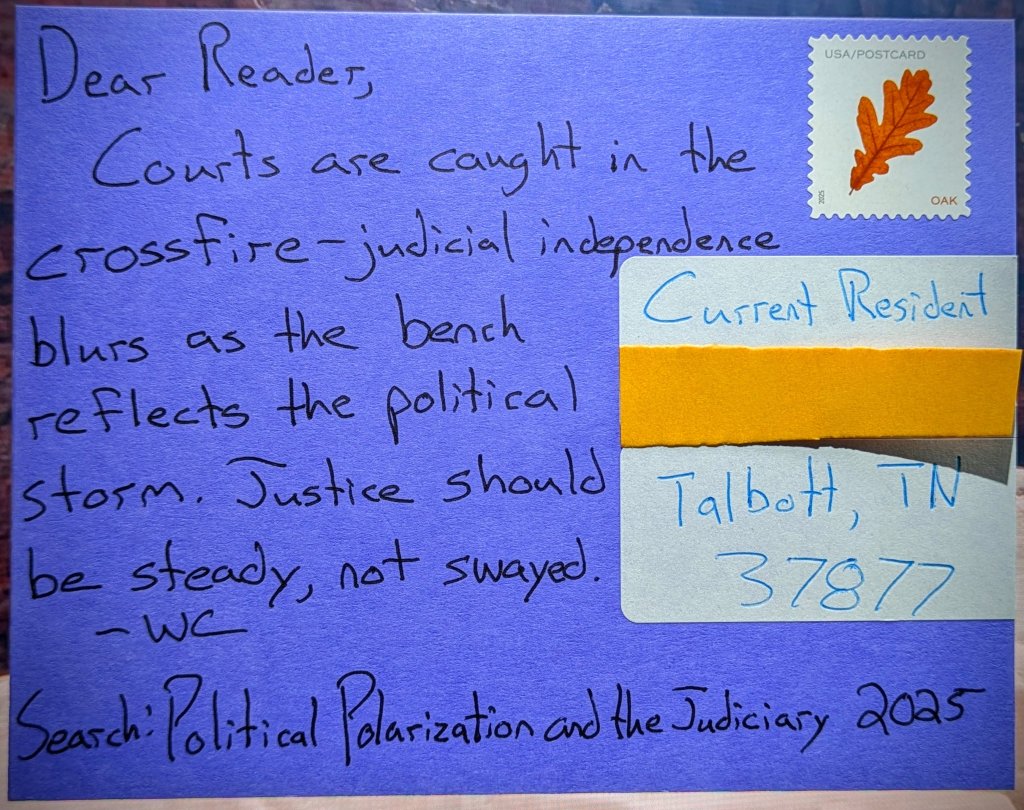
    Political polarization in Tennessee’s judiciary has become a significant issue in 2025, reflecting the broader national divide in how judges and courts align politically and ideologically. This polarization affects key court decisions and the day-to-day trust Tennesseans have in their legal system. For example, the Tennessee Supreme Court recently upheld a controversial law restricting gender-transition medical care for minors, reflecting strong ideological divides over social issues. This decision, welcomed by many conservatives, signals how judicial polarization influences rulings on sensitive topics, often splitting opinion sharply along party lines.

    For ordinary people in Tennessee, this polarization means court cases can feel more like political battles than neutral justice processes. Polarized judicial decisions can create confusion and unpredictability, especially in legal areas affecting personal rights, healthcare, and voting access. Tennesseans may find that their chances of winning a case or receiving protection under the law can depend heavily on the political leanings of the judges hearing their case. This can undermine confidence in the fairness of courts and make people feel that justice is not equally available to all, depending heavily on politics rather than law. For communities across Tennessee, such divisions can deepen social tensions and contribute to a sense that the judiciary is less a protector of rights than a site for political conflict.

    [Sources]

    https://www.tn.gov/attorneygeneral/news/2025/6/18/pr25-37.html

    https://statecourtreport.org/our-work/analysis-opinion/reflections-supreme-courts-decision-upholding-ban-gender-affirming-care

    https://news.vanderbilt.edu/2025/05/08/vanderbilt-poll-tennesseans-aligned-in-opposition-to-federal-funding-cuts-deeply-divided-on-presidential-powers/

    [Share | Subscribe | Follow]

    Instagram

    BlueSky

    X

    Pinterest

    Truth Social

    .

  • Justice Delayed

    Justice Delayed

    [Outgoing Mail]

    [Dec 17, 2025]

    Oklahoma’s lower courts are facing rising caseloads in 2025, creating a big problem for judges, lawyers, and everyday people trying to get their cases resolved. The state has responded by creating specialized business courts designed to handle complex business disputes more efficiently, which helps take some load off general district courts that handle a wide variety of cases, from accidents to family law to criminal trials. This new system aims to speed up complicated cases and reduce the backlog that slows down justice for ordinary Oklahomans. Lawmakers and the governor hope these courts will also attract businesses seeking fair and quick resolution in legal disputes, improving Oklahoma’s economy.

    For regular folks in Oklahoma, the rising caseload means longer waits for hearings, delayed justice, and more frustration. If someone is involved in a car accident, child custody battle, or criminal case, it can take months or even years for a final decision because judges are overwhelmed. This delay affects families needing legal closure, people waiting for compensation, or those wanting to move on with their lives. The backlog also puts pressure on local courts to find creative solutions like video hearings or expanding staff—but funding and personnel shortages remain a challenge. This means Oklahomans often face uncertainty, emotional stress, and financial pressure caused by an understaffed court system trying to handle more cases than ever before.

    [Sources]

    https://citizenportal.ai/articles/2329127/Oklahoma/Oklahoma-establishes-business-court-to-manage-increasing-caseloads

    [Share | Subscribe | Follow]

    Instagram

    BlueSky

    X

    Pinterest

    Truth Social

    .

  • Nostalgic For Inequality

    Nostalgic For Inequality

    [Outgoing Mail]

    [Dec 15, 2025]

    The Supreme Court’s focus on originalism by 2025 has sparked serious debate and criticism, including in states like Iowa. Originalism is the idea that judges should interpret the Constitution strictly as it was understood when it was written, without adapting to modern realities. Critics argue this approach limits justice by ignoring how society and its problems have changed over centuries. In Iowa, this tension plays out in important legal battles. For example, recent cases on voting rights and privacy show the state court and the U.S. Supreme Court wrestling with applying old constitutional ideas to modern issues like gun rights and local regulations. The Iowa Supreme Court, influenced by originalist ideas, ruled that abortion is not a guaranteed fundamental right under Iowa’s constitution, using a narrower, more strict reading of the legal text.

    For regular Iowans, the Court’s originalism focus can mean fewer protections and a legal system that fails to reflect today’s values or challenges. People face uncertainty on important issues like healthcare, equal rights, and the ability to participate in elections because courts increasingly rely on interpretations fixed in time instead of adapting laws to current conditions. This can make it harder for vulnerable groups—women, minorities, low-income families—to access justice or have their rights fully recognized. The result is a sense that the Court protects old traditions at the expense of fairness and progress, leaving many Iowans feeling that the law doesn’t work for them in the present day.

    [Sources]

    https://statecourtreport.org/our-work/analysis-opinion/state-justices-continue-challenge-originalism

    https://www.iowacourts.gov/courtcases/23246/embed/SupremeCourtOpinion

    https://firearmslaw.duke.edu/2025/02/are-state-constitutional-clauses-that-strengthen-gun-rights-relevant-after-bruen

    [Share | Subscribe | Follow]

    Instagram

    BlueSky

    X

    Pinterest

    Truth Social

    .

  • Fairness Froze

    Fairness Froze

    .[Outgoing Mail]

    [Dec 7, 2025]

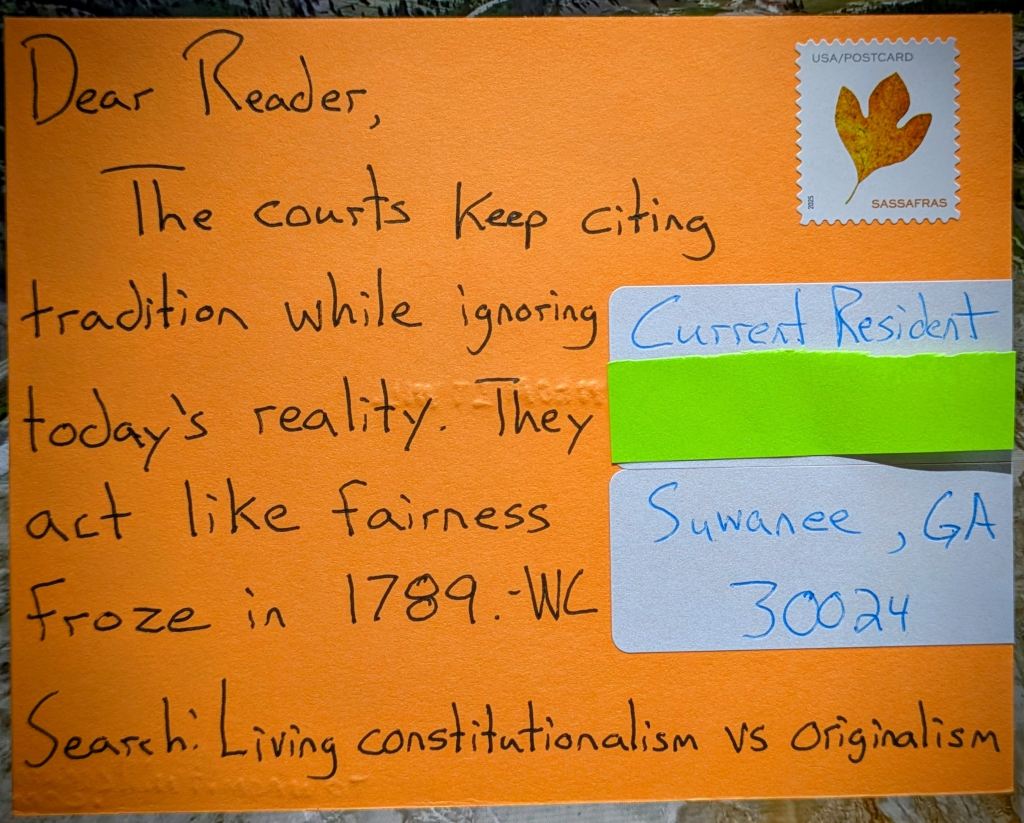
    The Supreme Court is deeply divided between two ways of thinking about the Constitution: “originalism” and “living constitutionalism.” Originalism means judges should only consider what the Constitution’s words meant when they were first written—like freezing its meaning in time, even when society changes. Living constitutionalism is the idea that the meaning can change as America changes; judges use today’s values and realities to make decisions about rights and laws. Right now, most Supreme Court justices call themselves originalists, arguing that this keeps judges tied to the people’s original intentions and stops courts from making up new rules. Living constitutionalists, on the other hand, say sticking only to old meanings makes it impossible to solve current problems when laws never imagined things like the internet or modern civil rights battles.

    For people in Georgia, the Supreme Court’s strong swing toward originalism can make life more unpredictable, especially around voting rights, criminal justice, and equality. Recent cases about how Georgia draws election districts, handles race in court trials, and deals with abortion clinics have all been shaped by justices asking, “What would the Founders say?” instead of “How does this affect Georgians today?”. For example, Georgia’s fight over voting maps is now decided based on rules from the 1800s, which can reduce protections against racial discrimination for voters in Atlanta and other urban areas. If the Supreme Court sticks to originalism in most big cases, laws affecting healthcare, social services, and public safety in Georgia could be harder to change to fit what communities need now. That means ordinary Georgians may struggle to get justice and fair treatment in court when the world changes faster than old constitutional ideas can keep up.

    [Sources]

    https://constitutioncenter.org/the-constitution/white-papers/on-originalism-in-constitutional-interpretation

    https://www.heritage.org/courts/commentary/how-originalism-became-the-prevailing-view-the-us-supreme-court

    .

    [Share | Subscribe | Follow]

    Instagram

    BlueSky

    X

    Pinterest

    Truth Social

    .

  • Winking

    Winking

    [Outgoing Mail]

    Oct 28, 2025

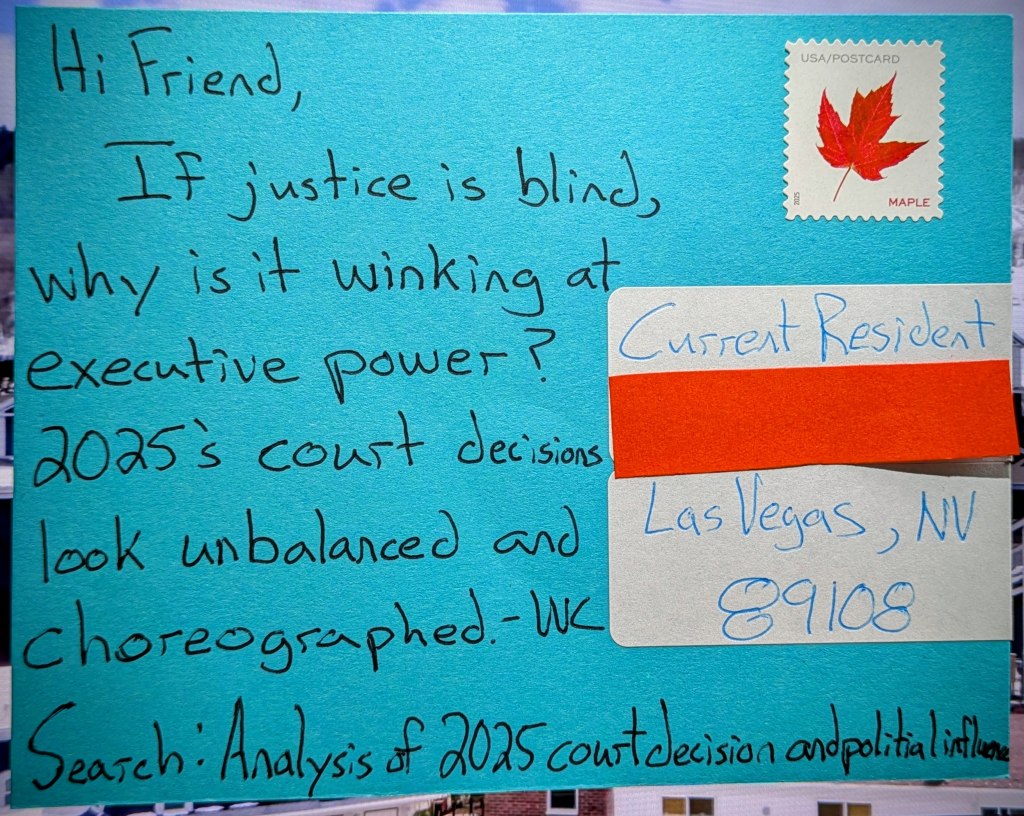
    In 2025, several major court decisions reshaped how the judiciary interacts with President Trump’s administration and the limits of executive power. The U.S. Supreme Court ruled that federal judges went too far when they blocked enforcement of Trump’s executive order ending birthright citizenship nationwide, saying that courts can only stop a policy for the people directly affected rather than issuing countrywide injunctions. That decision narrowed how much judges can restrain executive actions, signaling a broader judicial shift toward giving the president more control over executive agencies. Other rulings on emergency measures involving immigration, environmental regulation, and education funds also supported stronger presidential discretion, reflecting how the courts are currently defining the boundaries of presidential authority and legal oversight.

    In Nevada, this national trend mirrored local tensions between the state judiciary and executive functions. The Nevada Supreme Court reaffirmed that the courts cannot intrude into prosecutorial decisions, which belong to the state’s executive branch — meaning judges cannot block or direct which cases prosecutors pursue. When Trump’s executive orders touched Nevada policy, such as pausing federal clean energy funds, state courts and officials, including Attorney General Aaron Ford, joined multi-state suits challenging them as unconstitutional uses of executive power. Together, these developments show how the courts—federal and state—still act as referees in the tug-of-war between the judicial and executive branches, but are increasingly cautious about completely overruling presidential actions unless they clearly violate constitutionall boundaries.

    SOURCES

    https://www.law.columbia.edu/news/archive/columbia-law-experts-2025-supreme-court-rulings

  • Justice First, Not Politics

    Justice First, Not Politics

    Sep 27, 2025

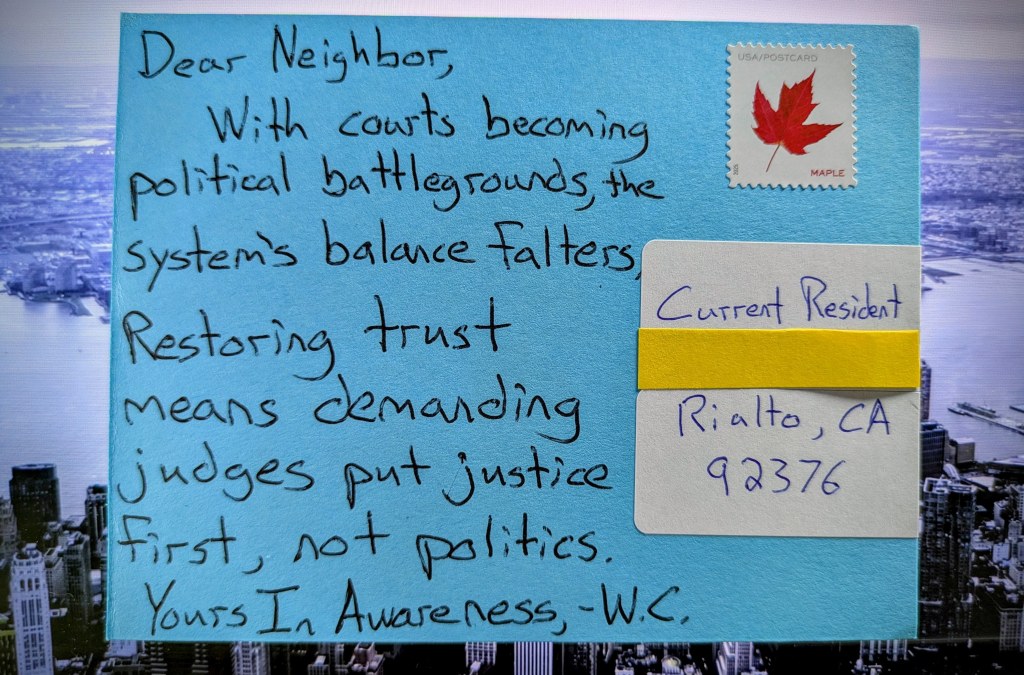
    The three key pillars that help build public trust in the judiciary are: Public commitment to democratic norms, unique symbols of the court (such as robes and honorific titles), and a court that is legalistic in it’s decisions.

    However, declining trust in all public institutions and political polarization makes this difficult. Recent issues-like Supreme Court nominations and the Dobbs decision-may have further weakened public confidence, despite the Justices assertions of fairness.

    The current Justices may not feel the immediate sting of dwindling trust, but history (and reliable public research) make clear the risks. They are undermining the institution’s authority and their own professional legacies, with consequences felt by all Americans.

    SOURCE

  • Judges Lean Partisan

    Judges Lean Partisan

    Sep 21, 2025

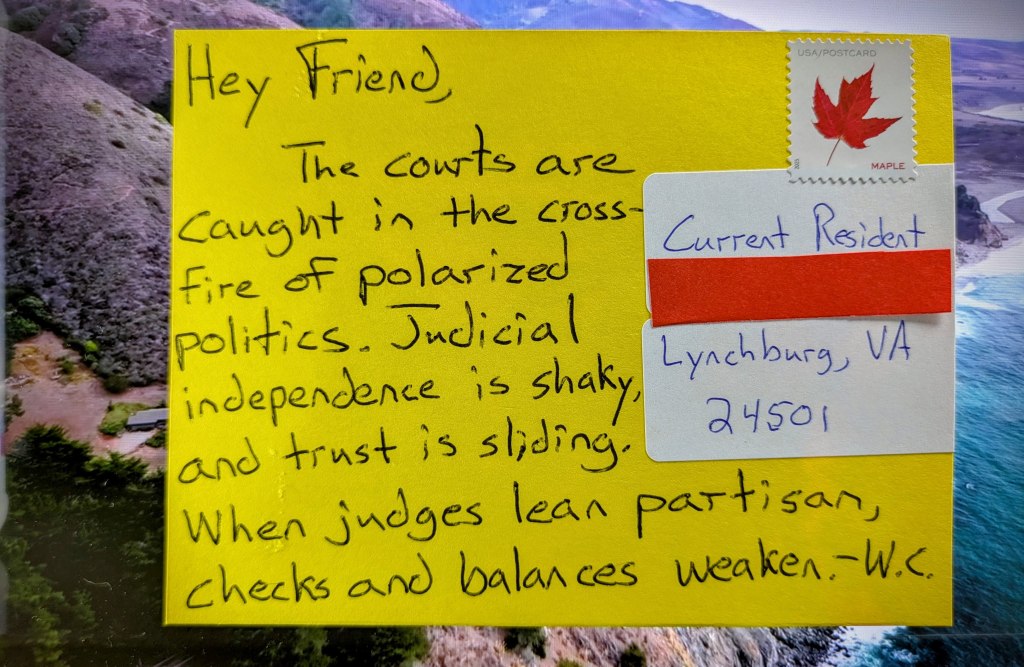
    Samuel Alito, known for reliable votes supporting right-wing and executive power positions, has been scrutinized over undisclosed trips and connections to conservative advocacy groups (as well as flag controversies involving his household). He is statistically the court’s most conservative justice. [1]

    Justice Clarence Thomas is extremely conservative, nearly always aligns with Alito and is a frequent leader of the most partisan bloc. His repeated headlines about unreported gifts, luxury trips, and financial benefits from conservative donors have raised major ethical concerns in 2024 and 2025, with Senate hearings and investigative journalism coverage. [2]

    Neil Gorsuch often aligns with the conservative bloc of Thomas and Alito on key issues. Brett Kavanaugh and Amy Coney Barrett are also conservative but are perceived as somewhat more moderate. John Roberts, the Chief Justice, has shifted right but remains the likely conservative swing vote, occasionally siding with liberals in close cases.

    By contrast, Sonia Sotomayor, Elena Kagan, and Ketanji Brown Jackson are seen as left-leaning but have mostly stayed out of major ethics controversies. Their dissenting opinions align with Democratic views.

    The combination of ethical concerns and partisan leanings fuels distrust and threatens the Court’s role as a fair, impartial guardian of democracy. The consequences of this erosion are felt by everyday Americans in their rights, protections, and faith in government institutions.

    SOURCES

    https://www.newsweek.com/clarence-thomas-samuel-alito-ethics-violations-found-new-senate-probe-2004585

  • Legal Backbone

    Legal Backbone

    Sep 20, 2025

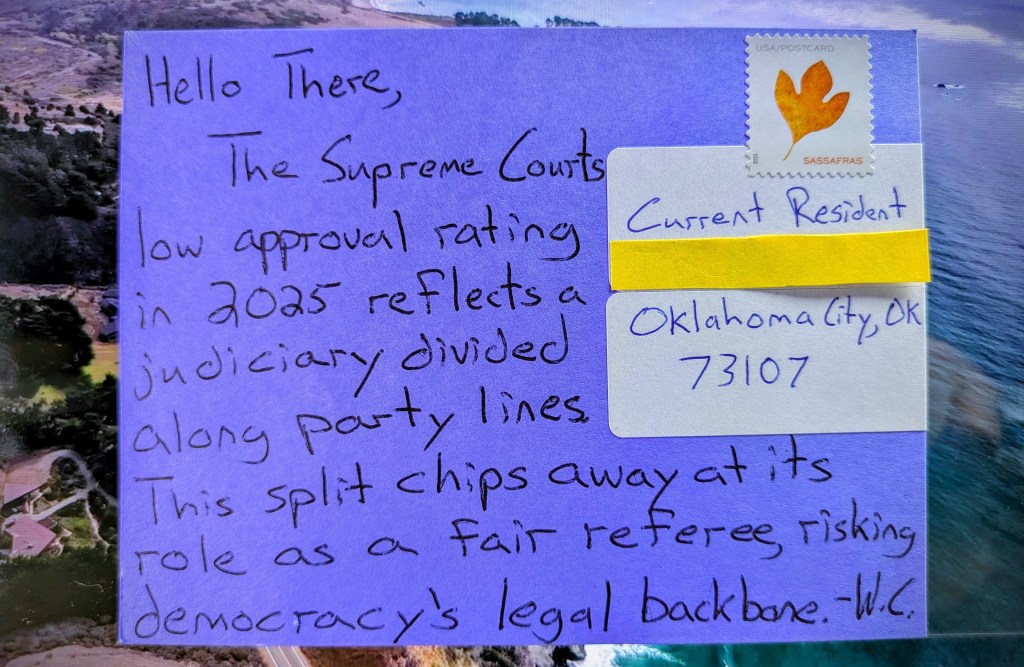
    The Supreme Court’s 41% approval rating in 2025 shows a divide between Republicans, who support the Court, and Democrats, who do not trust it, harming its impartiality and public confidence in important rulings.

    Historically, landmark cases like Brown v. Board of Education and Miranda v. Arizona show the power of an impartial Court to protect the rights of everyday Americans and uphold justice for all. These decisions broadened educational access and ensured fairness in legal proceedings, illustrating how balanced judicial leadership strengthens society. But today, the Court’s perceived politicization endangers its ability to perform that role effectively, leaving many Americans skeptical about whether justice truly is blind.

    When trust erodes, it weakens the Court’s power, increases social divisions, and threatens equal protection, making it vital for the judiciary to rebuild its independence and credibility.