Tag: atlanta

  • Not Just Drama

    Not Just Drama

    [Outgoing Mail]

    [Dec 26, 2025]

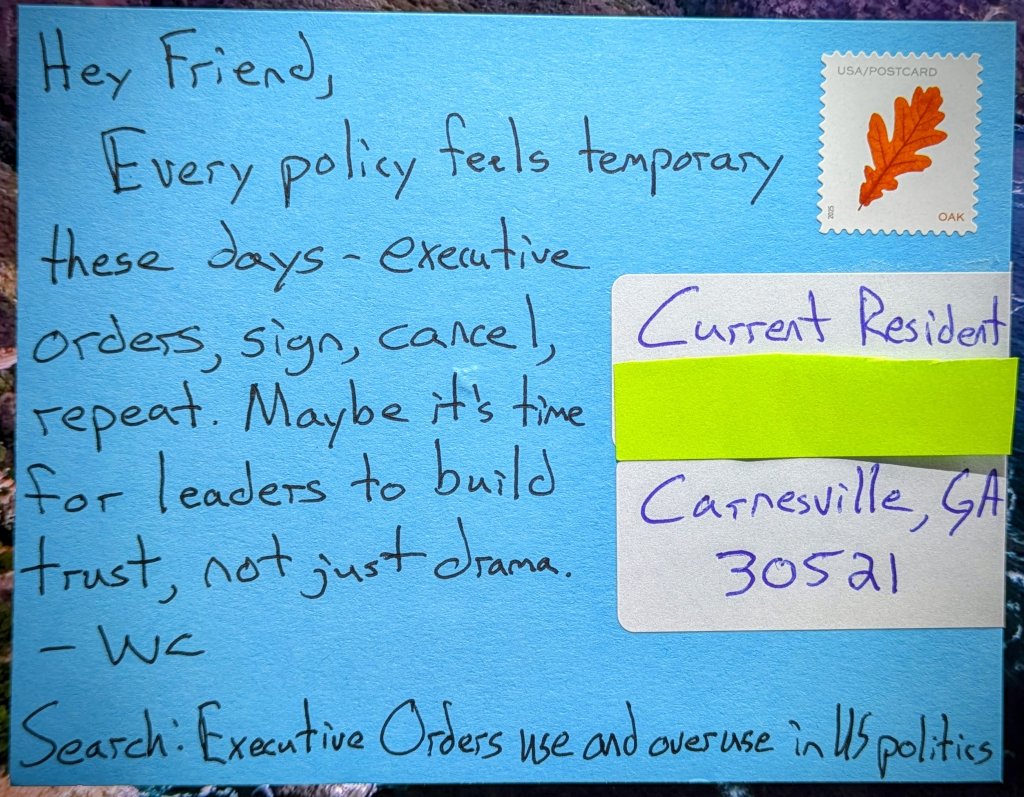
    President Trump has used executive orders a lot—more than 210 times this year alone. Executive orders are shortcuts a president uses to make rules or direct government agencies without needing Congress to pass a law. While these can be helpful for quick action, the problem is overuse. Too many executive orders can lead to confusion, because they can be changed just as fast by the next president, and often bypass the normal checks and balances that Congress provides. This creates uncertainty for government workers, businesses, and everyday people who need stable rules to plan their lives.

    In Georgia, this heavy use of executive orders is felt in daily life. For example, orders have changed things like how schools handle physical education, tariffs on imported goods, and healthcare drug pricing. These quick changes can disrupt local programs and services because Georgia’s schools, businesses, and health clinics have to adjust rapidly and often with little warning. For everyday Georgians, that means they may face confusion about what government programs are available, how to access them, or what new rules they must follow. It also means less chance for public debate and input on important decisions. While executive orders let the president act fast, relying on them too much can make people feel like their voices don’t matter and that government rules shift too quickly to trust.

    [Sources]

    https://ballotpedia.org/Donald_Trump’s_executive_orders_and_actions,_2025

    https://www.akingump.com/en/insights/blogs/trump-executive-order-tracker

    [Share | Subscribe | Follow]

    Instagram

    BlueSky

    X

    Pinterest

    Truth Social

    .

  • Fairness Froze

    Fairness Froze

    .[Outgoing Mail]

    [Dec 7, 2025]

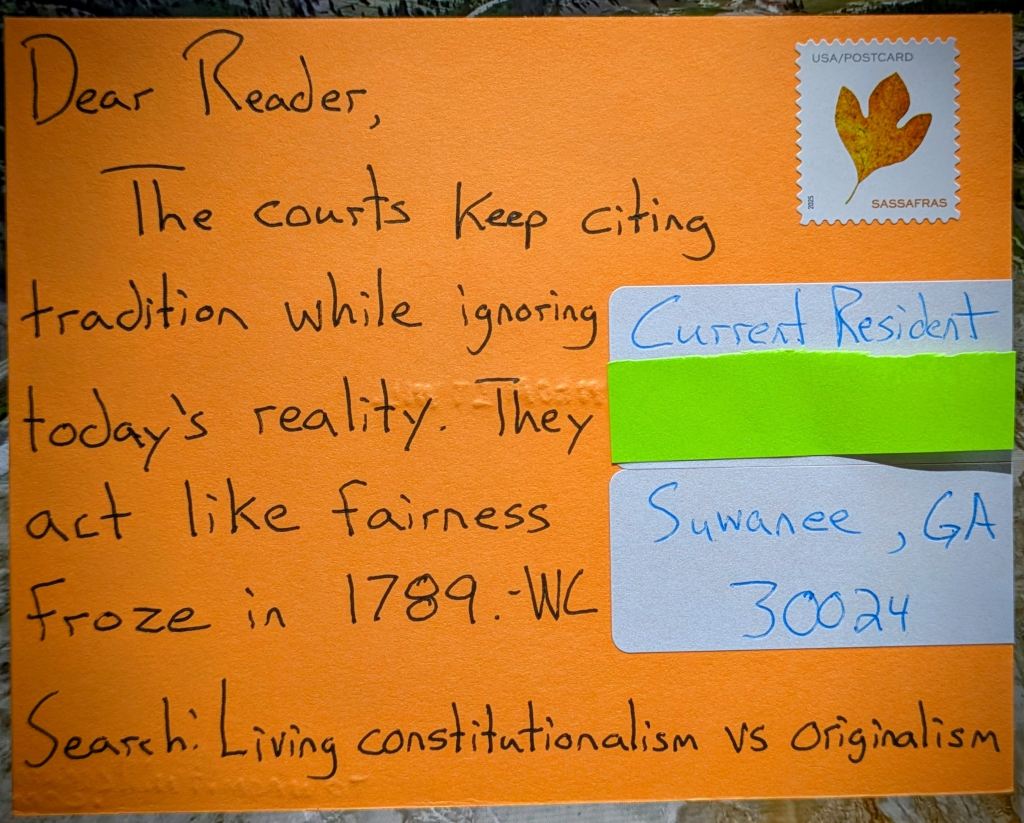
    The Supreme Court is deeply divided between two ways of thinking about the Constitution: “originalism” and “living constitutionalism.” Originalism means judges should only consider what the Constitution’s words meant when they were first written—like freezing its meaning in time, even when society changes. Living constitutionalism is the idea that the meaning can change as America changes; judges use today’s values and realities to make decisions about rights and laws. Right now, most Supreme Court justices call themselves originalists, arguing that this keeps judges tied to the people’s original intentions and stops courts from making up new rules. Living constitutionalists, on the other hand, say sticking only to old meanings makes it impossible to solve current problems when laws never imagined things like the internet or modern civil rights battles.

    For people in Georgia, the Supreme Court’s strong swing toward originalism can make life more unpredictable, especially around voting rights, criminal justice, and equality. Recent cases about how Georgia draws election districts, handles race in court trials, and deals with abortion clinics have all been shaped by justices asking, “What would the Founders say?” instead of “How does this affect Georgians today?”. For example, Georgia’s fight over voting maps is now decided based on rules from the 1800s, which can reduce protections against racial discrimination for voters in Atlanta and other urban areas. If the Supreme Court sticks to originalism in most big cases, laws affecting healthcare, social services, and public safety in Georgia could be harder to change to fit what communities need now. That means ordinary Georgians may struggle to get justice and fair treatment in court when the world changes faster than old constitutional ideas can keep up.

    [Sources]

    https://constitutioncenter.org/the-constitution/white-papers/on-originalism-in-constitutional-interpretation

    https://www.heritage.org/courts/commentary/how-originalism-became-the-prevailing-view-the-us-supreme-court

    .

    [Share | Subscribe | Follow]

    Instagram

    BlueSky

    X

    Pinterest

    Truth Social

    .

  • Keep Selling

    Keep Selling

    [Outgoing Mail]

    Nov 07, 2025

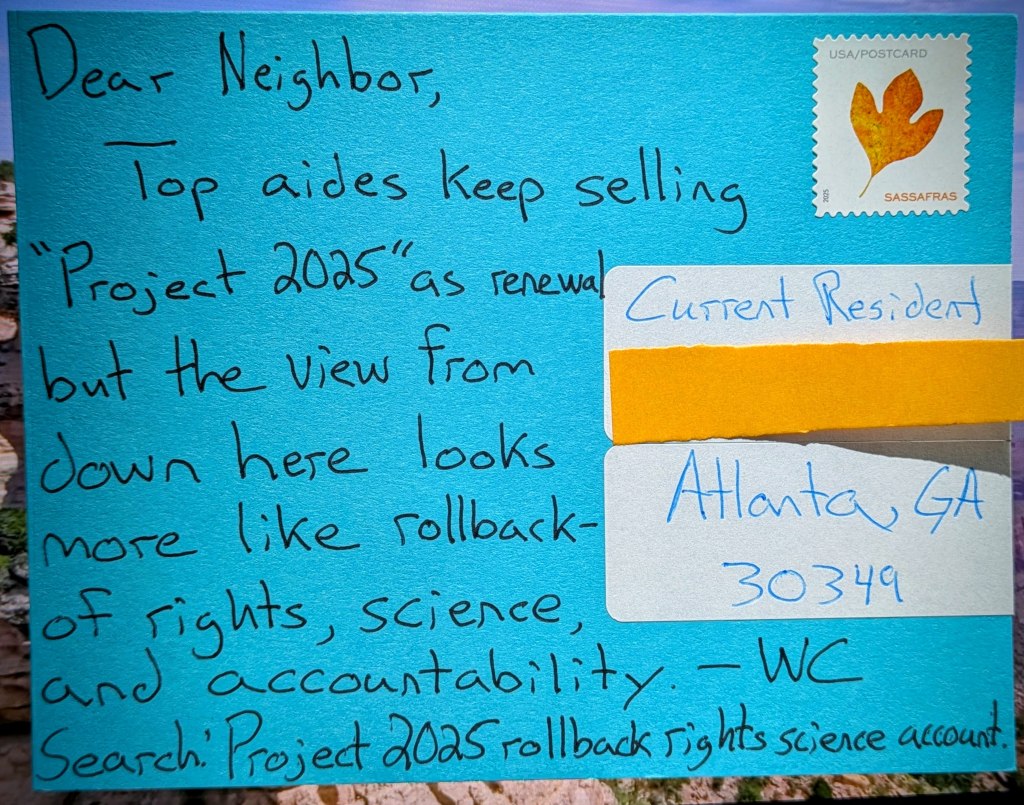
    Project 2025 has caused a sharp rollback in scientific research, human rights protections, and government accountability, creating serious concern among experts and civic groups. Reports from the Union of Concerned Scientists and the American Institute of Physics show that the plan strips key science agencies—like the Department of Energy and NOAA—of their independent voices, cutting climate programs, closing advisory boards, and reducing transparency for environmental data. These changes weaken the public’s ability to get factual information about issues like pollution or weather threats. At the same time, civil rights organizations warn that Project 2025 gives the president almost unchecked power to dismiss career officials and override public oversight laws, turning once-independent institutions into political tools. The policy framework reduces accountability by dismantling ethics offices and civil service protections, leaving fewer safeguards against misuse of power.

    In Atlanta, Georgia, these rollbacks have hit especially hard in education and local civic life. Project 2025’s plans to shrink or eliminate the Department of Education have already reduced federal support for Title I schools in Atlanta, which serve mostly low-income students. Local school leaders warn that these cuts deepen inequality for families already struggling with limited access to resources. Civil rights advocates, including the Urban League of Greater Atlanta and members of Georgia’s congressional delegation, have held events and press conferences calling the agenda a “sledgehammer to democracy” because it erodes voting rights, women’s reproductive freedom, and protections for LGBTQ+ citizens. For many Atlantan activists and educators, the concern is not just losing federal funding or research—it’s losing the ability to hold powerful people accountable when their actions harm communities.

    SOURCES

    https://ulgatl.org/on-point-exclusive-unpacking-project-2025-in-real-time-with-the-urban-league-of-greater-atlanta/

    https://www.aip.org/fyi/project-2025-outlines-possible-future-for-science-agencies

    [Share & Follow]

    Instagram

    Pinterest