Tag: news

  • Not Just Drama

    Not Just Drama

    [Outgoing Mail]

    [Dec 26, 2025]

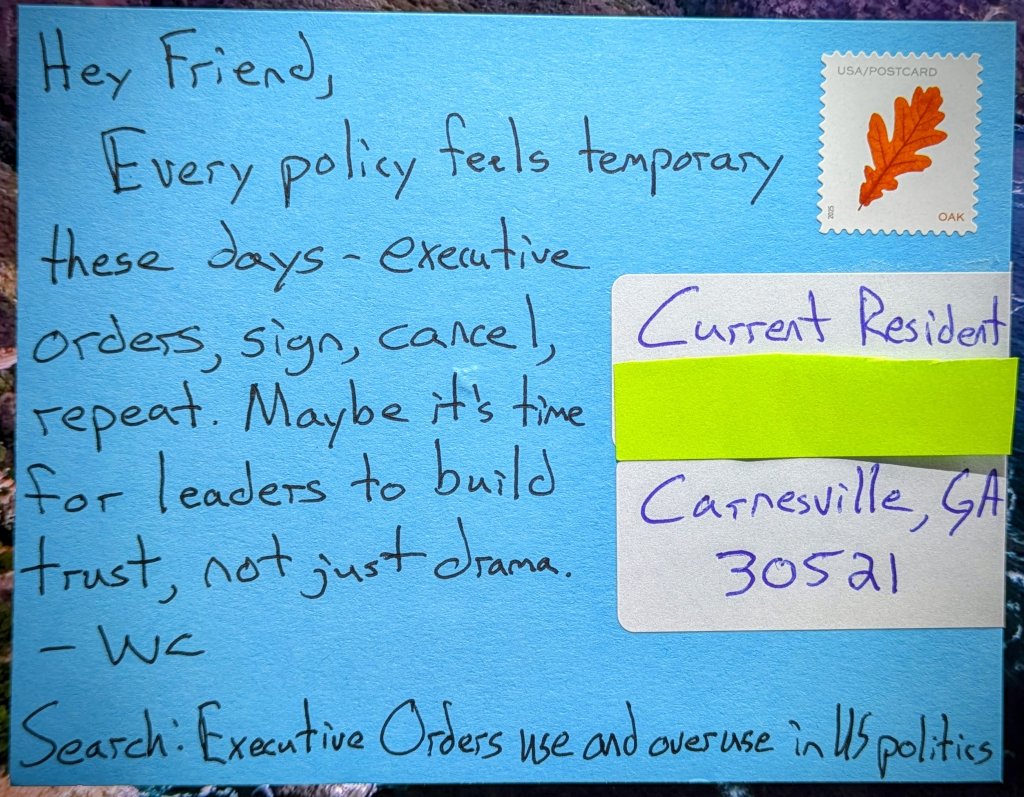
    President Trump has used executive orders a lot—more than 210 times this year alone. Executive orders are shortcuts a president uses to make rules or direct government agencies without needing Congress to pass a law. While these can be helpful for quick action, the problem is overuse. Too many executive orders can lead to confusion, because they can be changed just as fast by the next president, and often bypass the normal checks and balances that Congress provides. This creates uncertainty for government workers, businesses, and everyday people who need stable rules to plan their lives.

    In Georgia, this heavy use of executive orders is felt in daily life. For example, orders have changed things like how schools handle physical education, tariffs on imported goods, and healthcare drug pricing. These quick changes can disrupt local programs and services because Georgia’s schools, businesses, and health clinics have to adjust rapidly and often with little warning. For everyday Georgians, that means they may face confusion about what government programs are available, how to access them, or what new rules they must follow. It also means less chance for public debate and input on important decisions. While executive orders let the president act fast, relying on them too much can make people feel like their voices don’t matter and that government rules shift too quickly to trust.

    [Sources]

    https://ballotpedia.org/Donald_Trump’s_executive_orders_and_actions,_2025

    https://www.akingump.com/en/insights/blogs/trump-executive-order-tracker

    [Share | Subscribe | Follow]

    Instagram

    BlueSky

    X

    Pinterest

    Truth Social

    .

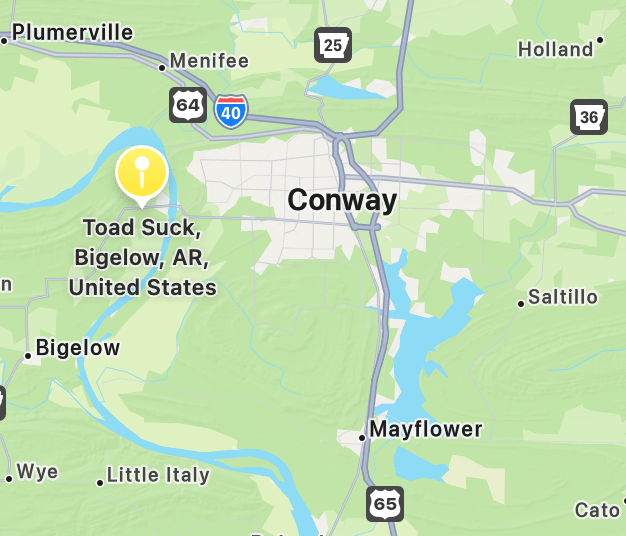
  • Toad Suck, AR

    Toad Suck, AR

    [Outgoing Mail]

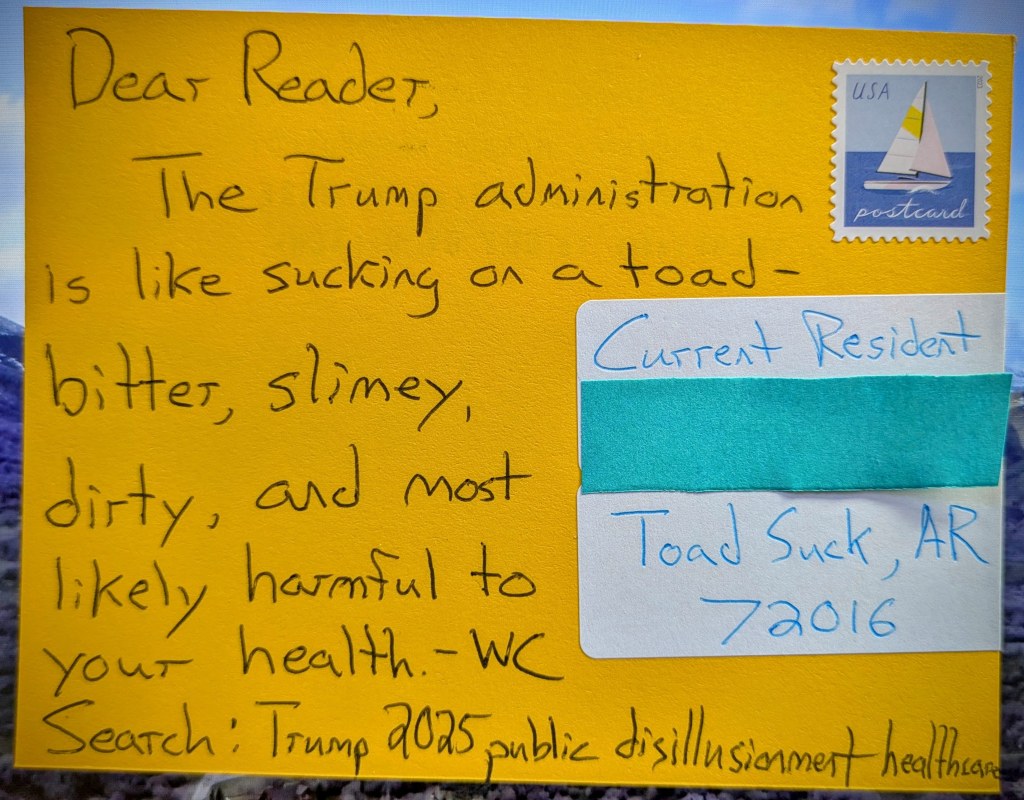
    [Dec 21, 2025 | Postscape #044]

    Many Americans are feeling frustrated and disillusioned about healthcare, especially under President Trump’s policies. Many see the government’s decisions as making healthcare harder and more expensive to get, not easier. Trump’s major law changes this year, known as the “Big Beautiful Bill,” rolled back Medicaid and cut benefits for low-income families, while also weakening protections for those who buy insurance on their own. A recent poll shows that more than 8 in 10 Americans worry about insurance becoming unaffordable and millions losing coverage. Despite Trump’s focus on healthcare as a key issue, many people don’t trust him to handle it well, with only 31% approving of how he’s managing the system. The cuts mainly serve to finance tax breaks for wealthy Americans, while low-income families are left struggling without affordable options.

    In Arkansas, these problems hit especially hard. Arkansas already faces high rates of poverty and chronic illness, so losing Medicaid coverage or seeing food assistance cut feels like a disaster for thousands of families. Hospitals and clinics in rural Arkansas are stretched thin trying to treat more uninsured patients, and families often delay care because they can’t afford it. Many Arkansans have to make tough choices between paying for medicine, food, or rent, and the rollback of healthcare supports makes those choices even tougher. This growing healthcare crisis is making it clear for folks in Arkansas that promises from Washington don’t always translate into better health or security on the ground.

    [Sources]

    https://apnorc.org/projects

    [Share | Subscribe | Follow]

    Instagram

    BlueSky

    X

    Pinterest

    Truth Social

    .

  • Steady, Not Swayed

    Steady, Not Swayed

    [Outgoing Mail]

    [Dec 19, 2025]

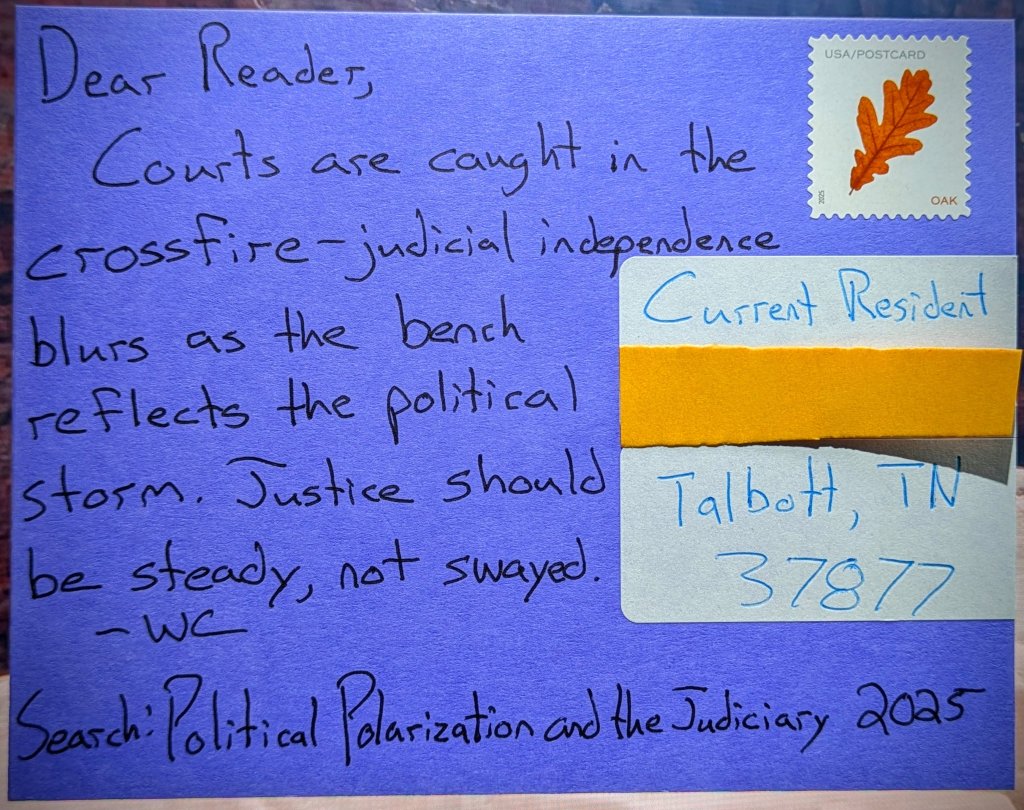
    Political polarization in Tennessee’s judiciary has become a significant issue in 2025, reflecting the broader national divide in how judges and courts align politically and ideologically. This polarization affects key court decisions and the day-to-day trust Tennesseans have in their legal system. For example, the Tennessee Supreme Court recently upheld a controversial law restricting gender-transition medical care for minors, reflecting strong ideological divides over social issues. This decision, welcomed by many conservatives, signals how judicial polarization influences rulings on sensitive topics, often splitting opinion sharply along party lines.

    For ordinary people in Tennessee, this polarization means court cases can feel more like political battles than neutral justice processes. Polarized judicial decisions can create confusion and unpredictability, especially in legal areas affecting personal rights, healthcare, and voting access. Tennesseans may find that their chances of winning a case or receiving protection under the law can depend heavily on the political leanings of the judges hearing their case. This can undermine confidence in the fairness of courts and make people feel that justice is not equally available to all, depending heavily on politics rather than law. For communities across Tennessee, such divisions can deepen social tensions and contribute to a sense that the judiciary is less a protector of rights than a site for political conflict.

    [Sources]

    https://www.tn.gov/attorneygeneral/news/2025/6/18/pr25-37.html

    https://statecourtreport.org/our-work/analysis-opinion/reflections-supreme-courts-decision-upholding-ban-gender-affirming-care

    https://news.vanderbilt.edu/2025/05/08/vanderbilt-poll-tennesseans-aligned-in-opposition-to-federal-funding-cuts-deeply-divided-on-presidential-powers/

    [Share | Subscribe | Follow]

    Instagram

    BlueSky

    X

    Pinterest

    Truth Social

    .

  • Justice Delayed

    Justice Delayed

    [Outgoing Mail]

    [Dec 17, 2025]

    Oklahoma’s lower courts are facing rising caseloads in 2025, creating a big problem for judges, lawyers, and everyday people trying to get their cases resolved. The state has responded by creating specialized business courts designed to handle complex business disputes more efficiently, which helps take some load off general district courts that handle a wide variety of cases, from accidents to family law to criminal trials. This new system aims to speed up complicated cases and reduce the backlog that slows down justice for ordinary Oklahomans. Lawmakers and the governor hope these courts will also attract businesses seeking fair and quick resolution in legal disputes, improving Oklahoma’s economy.

    For regular folks in Oklahoma, the rising caseload means longer waits for hearings, delayed justice, and more frustration. If someone is involved in a car accident, child custody battle, or criminal case, it can take months or even years for a final decision because judges are overwhelmed. This delay affects families needing legal closure, people waiting for compensation, or those wanting to move on with their lives. The backlog also puts pressure on local courts to find creative solutions like video hearings or expanding staff—but funding and personnel shortages remain a challenge. This means Oklahomans often face uncertainty, emotional stress, and financial pressure caused by an understaffed court system trying to handle more cases than ever before.

    [Sources]

    https://citizenportal.ai/articles/2329127/Oklahoma/Oklahoma-establishes-business-court-to-manage-increasing-caseloads

    [Share | Subscribe | Follow]

    Instagram

    BlueSky

    X

    Pinterest

    Truth Social

    .

  • Nostalgic For Inequality

    Nostalgic For Inequality

    [Outgoing Mail]

    [Dec 15, 2025]

    The Supreme Court’s focus on originalism by 2025 has sparked serious debate and criticism, including in states like Iowa. Originalism is the idea that judges should interpret the Constitution strictly as it was understood when it was written, without adapting to modern realities. Critics argue this approach limits justice by ignoring how society and its problems have changed over centuries. In Iowa, this tension plays out in important legal battles. For example, recent cases on voting rights and privacy show the state court and the U.S. Supreme Court wrestling with applying old constitutional ideas to modern issues like gun rights and local regulations. The Iowa Supreme Court, influenced by originalist ideas, ruled that abortion is not a guaranteed fundamental right under Iowa’s constitution, using a narrower, more strict reading of the legal text.

    For regular Iowans, the Court’s originalism focus can mean fewer protections and a legal system that fails to reflect today’s values or challenges. People face uncertainty on important issues like healthcare, equal rights, and the ability to participate in elections because courts increasingly rely on interpretations fixed in time instead of adapting laws to current conditions. This can make it harder for vulnerable groups—women, minorities, low-income families—to access justice or have their rights fully recognized. The result is a sense that the Court protects old traditions at the expense of fairness and progress, leaving many Iowans feeling that the law doesn’t work for them in the present day.

    [Sources]

    https://statecourtreport.org/our-work/analysis-opinion/state-justices-continue-challenge-originalism

    https://www.iowacourts.gov/courtcases/23246/embed/SupremeCourtOpinion

    https://firearmslaw.duke.edu/2025/02/are-state-constitutional-clauses-that-strengthen-gun-rights-relevant-after-bruen

    [Share | Subscribe | Follow]

    Instagram

    BlueSky

    X

    Pinterest

    Truth Social

    .

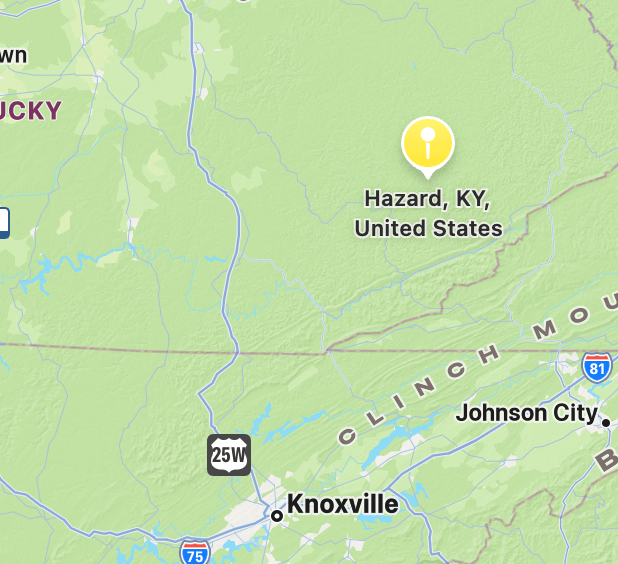
  • Hazard, KY

    Hazard, KY

    [Outgoing Mail]

    [Dec 13, 2025 | Postscape #043]

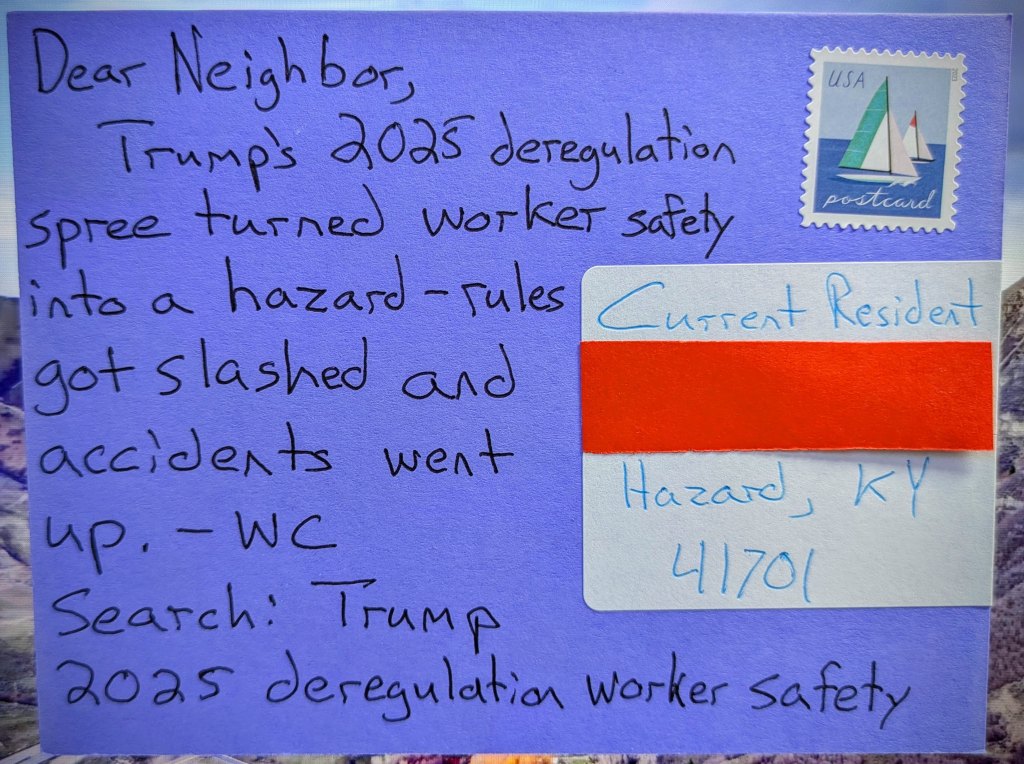
    President Trump’s administration is aggressively rolling back workplace safety rules and other regulations under the banner of deregulation. This means cutting laws and protections designed to keep workers safe on the job and ensure fair wages. The Department of Labor has proposed weakening more than 60 regulations that cover everything from mine safety, farmworker protections, and construction site rules to protections for home health care workers and people with disabilities. These rollbacks include limiting what employers must do to protect workers from known dangers and giving workers less say in choosing safety gear. Critics say this puts workers at greater risk of injury or illness because some regulations protect people from harmful substances or dangerous conditions that haven’t changed. Meanwhile, the administration argues these rules hold back economic growth and burden employers too much.

    For Kentucky, a state with many workers in industries like coal mining, manufacturing, and agriculture, these deregulations hit home hard. Many Kentuckians rely on strong safety rules to prevent accidents and illnesses—without them, hospital visits and workplace injuries are likely to increase, costing families both health and income. Coal miners, farm laborers, and construction workers in Kentucky are among those most at risk from looser federal protections because their jobs involve exposure to dangerous conditions every day. Additionally, wage protections for home health workers—important in rural Kentucky—are being rolled back, which means fewer hours, less pay, and less support for some of the state’s most vulnerable workers. In everyday terms, these changes mean Kentucky’s workers face tougher, more dangerous jobs with fewer safeguards while their incomes and quality of life may suffer, deepening inequalities and making Kentucky’s working families more vulnerable.

    [Sources]

    https://www.epi.org/blog/trumps-department-of-labor-is-dismantling-key-workplace-protections/

    https://tcf.org/content/commentary/trumps-department-of-labor-continues-its-onslaught-against-workers/

    https://www.livenowfox.com/news/trump-labor-deregulation-rules

    https://www.morganlewis.com/pubs/2025/07/oshas-aggressive-deregulatory-efforts-begin

    https://thedailyrecord.com/2025/07/22/labor-department-worker-safety-regulations-repeal/

    [Share | Subscribe | Follow]

    BlueSky

    Pinterest

    Truth Social

  • It’s Neglect

    It’s Neglect

    [Outgoing Mail]

    [Dec 11, 2025]

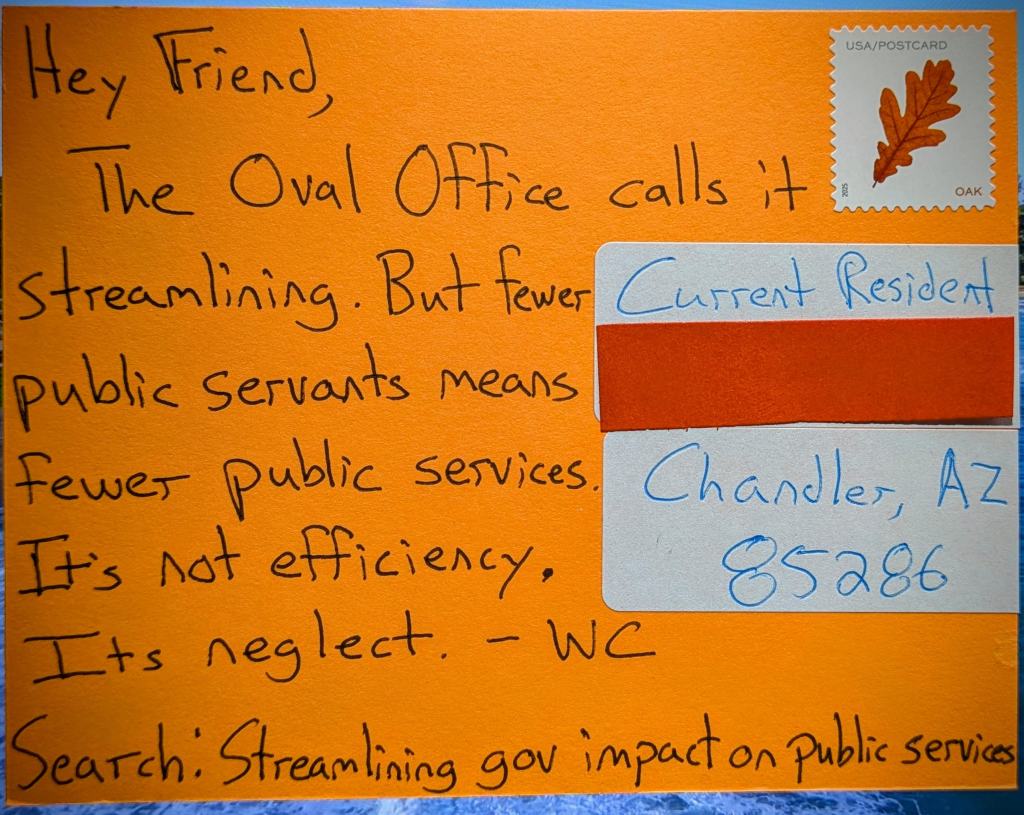
    Trump’s “streamlining” of government services mainly means cutting back on federal programs, staff, and offices to make things run cheaper and faster—but for the people who rely on these services, that often means getting less help when they need it most. Trump’s administration directed agencies to shed thousands of federal jobs, shut down regional offices, freeze new hirings, and eliminate programs it called “unnecessary”. Rules were changed so that only one new person was hired for every four who left, and agencies were told to automate tasks and use fewer outside contractors. The White House claimed the government would stay “efficient,” but many watchdogs and public service unions warned that basic help for Americans—like help with healthcare, job training, or disaster relief—was harder to get and slower than before.

    In Arizona, these cutbacks hit home in a bunch of ways. Local offices of agencies like Social Security, veterans’ services, and child care support were consolidated or closed, forcing Arizonans to drive hundreds of miles or spend hours online just to get help. Programs that helped poor families with Head Start preschool, Medicaid, and housing assistance were either shrunk, rolled into new “work requirements” that knocked people off the rolls, or eliminated outright. Arizona’s border communities, including cities like Tucson and Nogales, now see more confusion and longer waits for things like disaster recovery after storms or access to government health clinics. Teachers and social workers in Phoenix say the paperwork load got heavier after the federal government dumped tough jobs onto state agencies without enough money or clear rules to handle the surge. So, what’s called “streamlining” often means everyday folks in Arizona get caught in longer lines, face higher costs, and have to work harder just to get their basic needs met by a government that says it’s focusing on efficiency.

    [Sources]

    https://www.ncsl.org/in-dc/2025-administration-actions-key-executive-orders-and-policies

    https://www.whitehouse.gov/fact-sheets/2025/10/fact-sheet-president-donald-j-trump-ensures-continued-accountability-in-federal-hiring/

    .

    [Share | Subscribe | Follow]

    Instagram

    BlueSky

    X

    Pinterest

    Truth Social

    .

  • Party Pressure

    Party Pressure

    [Outgoing Mail]

    [Dec 09, 2025]

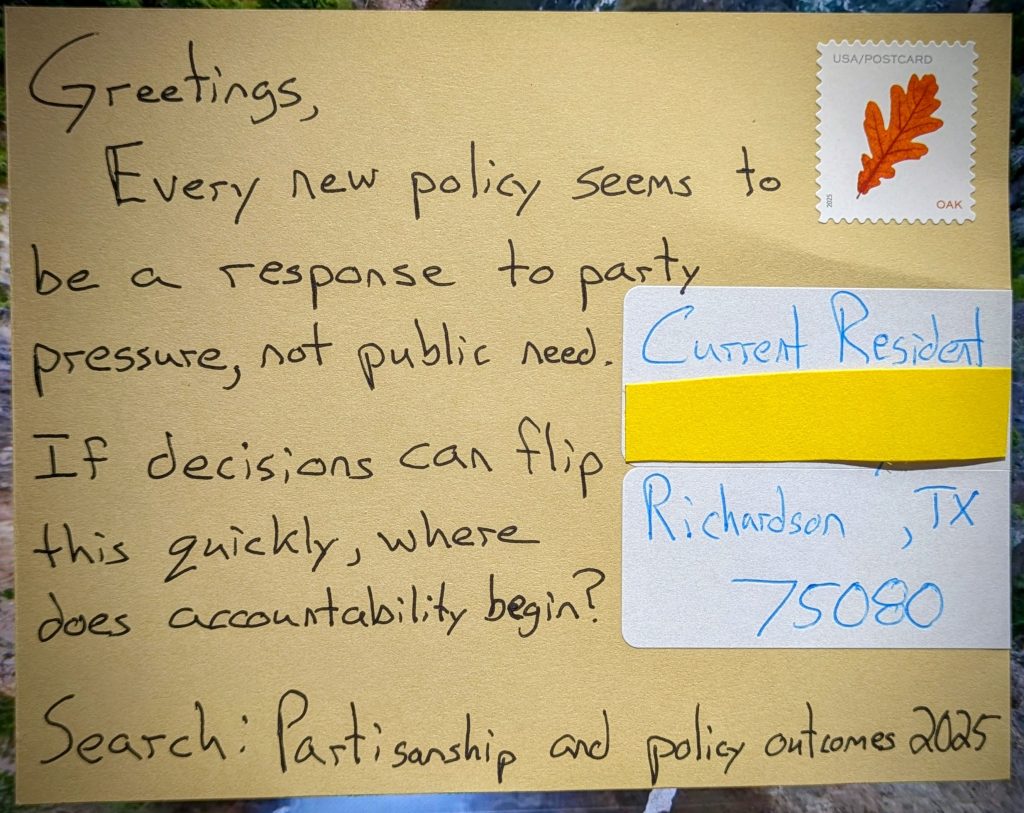
    Congress is more divided and partisan than ever, leading to slow progress on the big issues that matter most to regular people. Republicans control both the House and Senate, but with extremely slim majorities—the House has only a five-seat Republican edge, and the Senate just a few seats more. Because the margins are so tight, party members rarely cross the aisle to work with the other side. Instead, politicians spend more time fighting, blocking each other’s plans, and focusing on decisions that mostly please their most loyal supporters. This constant back-and-forth makes it hard for Congress to pass meaningful laws on things like healthcare costs, border security, or fixing roads, which leaves many Americans feeling frustrated and ignored.

    For Texans, this gridlock in Congress can be felt in their everyday lives. When lawmakers in Washington argue instead of act, essential funding for Texas schools, highways, and disaster recovery gets delayed or lost. For example, families who are still recovering from floods or severe storms depend on quick federal help, but political fighting can slow disaster relief payments. Texas farmers, oil workers, and small business owners also face uncertainty because Congress can’t agree on stable trade policies, energy rules, or long-term tax plans. As a result, many Texans feel that Congress is more interested in winning political games than in solving the real problems that hit home. This lack of progress has left people in Texas waiting for solutions that never come, deepening the sense that Washington doesn’t have their backs.

    [Sources]

    https://www.pewresearch.org/short-reads/2024/12/17/slim-majorities-have-become-more-common-in-the-us-house-and-senate/

    https://about.bgov.com/insights/congress/balance-of-power-in-the-u-s-house-and-senate/

    https://en.wikipedia.org/wiki/119th_United_States_Congress

    https://www.apmresearchlab.org/us-house-senate-control-2025

    .

    [Share | Subscribe | Follow]

    Instagram

    BlueSky

    X

    Pinterest

    Truth Social

    .

  • Fairness Froze

    Fairness Froze

    .[Outgoing Mail]

    [Dec 7, 2025]

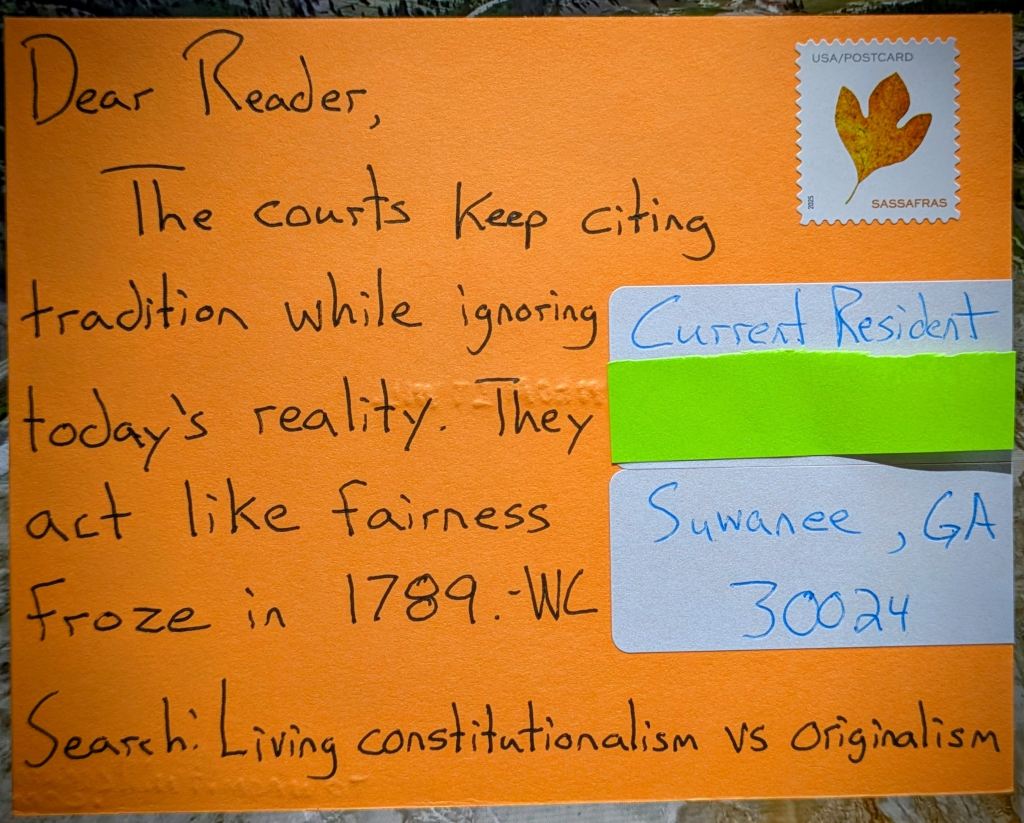
    The Supreme Court is deeply divided between two ways of thinking about the Constitution: “originalism” and “living constitutionalism.” Originalism means judges should only consider what the Constitution’s words meant when they were first written—like freezing its meaning in time, even when society changes. Living constitutionalism is the idea that the meaning can change as America changes; judges use today’s values and realities to make decisions about rights and laws. Right now, most Supreme Court justices call themselves originalists, arguing that this keeps judges tied to the people’s original intentions and stops courts from making up new rules. Living constitutionalists, on the other hand, say sticking only to old meanings makes it impossible to solve current problems when laws never imagined things like the internet or modern civil rights battles.

    For people in Georgia, the Supreme Court’s strong swing toward originalism can make life more unpredictable, especially around voting rights, criminal justice, and equality. Recent cases about how Georgia draws election districts, handles race in court trials, and deals with abortion clinics have all been shaped by justices asking, “What would the Founders say?” instead of “How does this affect Georgians today?”. For example, Georgia’s fight over voting maps is now decided based on rules from the 1800s, which can reduce protections against racial discrimination for voters in Atlanta and other urban areas. If the Supreme Court sticks to originalism in most big cases, laws affecting healthcare, social services, and public safety in Georgia could be harder to change to fit what communities need now. That means ordinary Georgians may struggle to get justice and fair treatment in court when the world changes faster than old constitutional ideas can keep up.

    [Sources]

    https://constitutioncenter.org/the-constitution/white-papers/on-originalism-in-constitutional-interpretation

    https://www.heritage.org/courts/commentary/how-originalism-became-the-prevailing-view-the-us-supreme-court

    .

    [Share | Subscribe | Follow]

    Instagram

    BlueSky

    X

    Pinterest

    Truth Social

    .

  • Scratch Ankle, AL

    Scratch Ankle, AL

    [Outgoing Mail]

    [Dec 05, 2025 | Postscape #042]

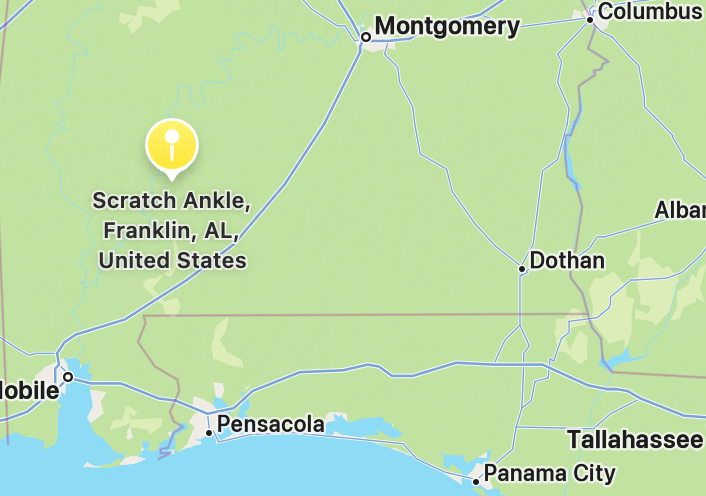
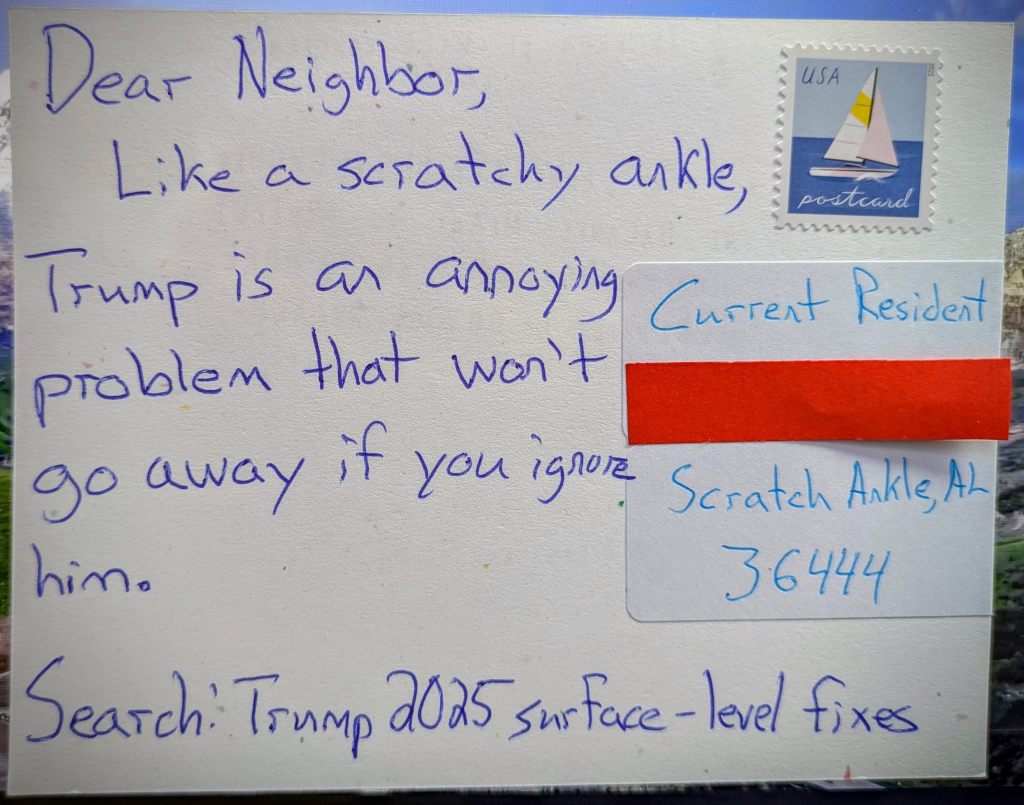
    Trump’s government has been rolling out what many call surface-level fixes—actions that look flashy on the outside but don’t really address deeper problems. These policies often grab headlines and make big promises, like getting rid of entire government departments, slashing regulations, or sending troops to the border. For example, Trump ordered the Department of Education to close, banned all federal diversity programs, and tried to shift disaster recovery costs from Washington to states, claiming this would save money and make the government run smoother. But experts point out these moves usually don’t fix the real issues that Americans face day after day. Instead, they often create confusion, push costs onto state governments and local communities, and end up making life trickier for regular families.

    What does all this mean for everyday Americans? Most people notice little real improvement in their lives from these surface-level fixes. For instance, when Trump cut education funding and handed off disaster aid to the states, local schools and emergency services had less money to help families when they really needed it. Big executive orders to beef up border security or slash university research spending might sound strong, but they often don’t make neighborhoods safer or boost paychecks—they can even create new headaches and uncertainty for folks trying to send their kids to school or recover from a flood. In a nutshell, these flashy changes look good in political speeches, but they rarely get to the heart of the problems facing Americans trying to get ahead, support their kids, or bounce back from tough times.

    [Sources]

    https://www.max-security.com/resources/global-forecast/trump-policy-shifts-2025/

    https://russellinvestments.com/content/ri/us/en/insights/russell-research/2024/12/an-investor_s-guide-to-potential-us-policy-changes-in-2025.html

    https://www.cbsnews.com/news/trump-project-2025-first-100-days/

    [Share | Subscribe | Follow]

    Instagram

    BlueSky

    X

    Pinterest

    Truth Social

    .