
[Outgoing Mail]
Nov 4, 2025
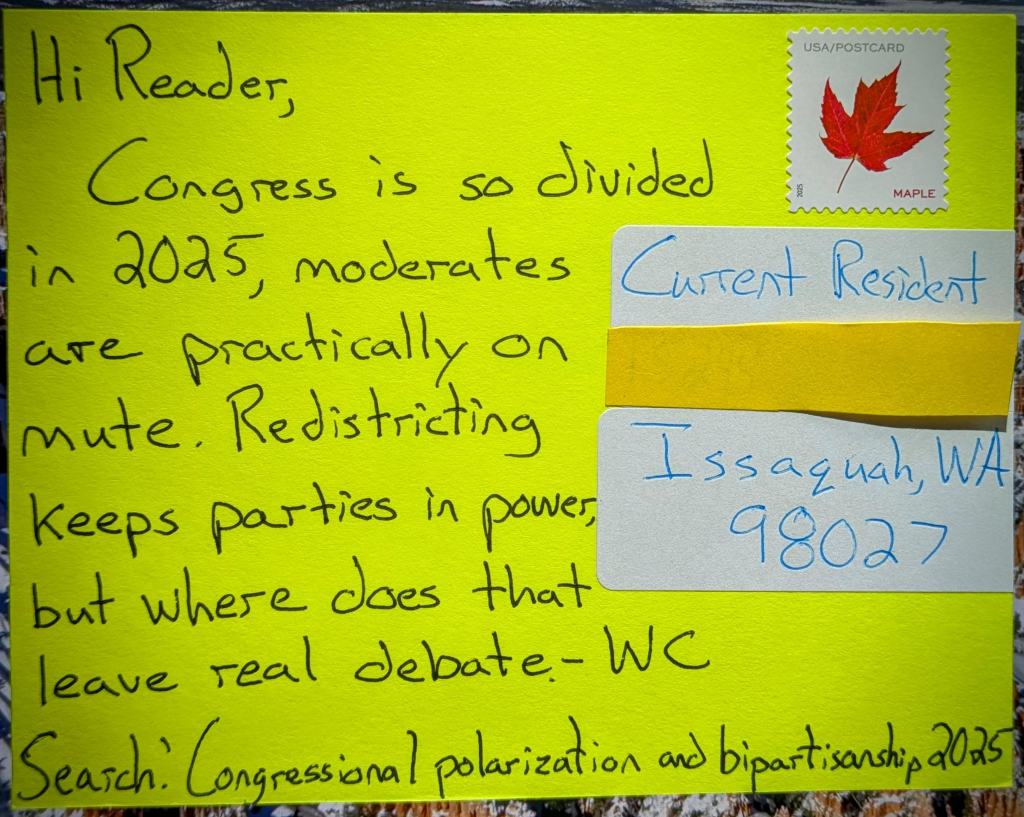
Congress in 2025 has remained sharply divided, with polarization continuing to shape how politicians act and how few laws are passed. Researchers at the Carnegie Corporation and Pew Research Center report that both parties have grown more distant from one another not only on issues like abortion and climate change but in the way they view the basic role of government. Redistricting pushed by both parties—encouraged by President Trump’s allies in states they control—has worsened polarization by locking in safe seats where representatives have little reason to compromise. As a result, partisan gridlock is common, and bipartisanship, while not completely gone, is limited mainly to issues like defense spending and foreign policy where both sides see shared national interests. Even former lawmakers now admit that the “political hatred” between parties has reached a level where cooperation is difficult unless voters directly punish dysfunction.
Washington state reflects this national pattern but shows glimmers of balance. Its congressional delegation for 2025 is dominated by Democrats—ten Democrats and two Republicans—but includes a few moderates, like Democrat Marie Gluesenkamp Perez and Republican Dan Newhouse, who have resisted the extremes of their parties. Both have been targeted by activists from their own sides, highlighting how polarization pressures even those who work across the aisle. At the same time, Washington’s political structure, with statewide mail-in voting and strong independent voter blocs, has helped sustain some degree of local bipartisanship, particularly in rural infrastructure and forestry policy. Still, the state’s mostly one-party delegation mirrors the national pattern where electoral maps and party loyalty leave little room for compromise—showing that polarization in Washington, like in Congress, is more the rule than the exception
SOURCES
https://ballotpedia.org/United_States_congressional_delegations_from_Washington
https://www.carnegie.org/our-work/article/why-polarization-is-a-problem/
https://onlinelibrary.wiley.com/doi/10.1111/polp.70082?af=R
https://home.dartmouth.edu/news/2025/09/research-shows-there-are-no-easy-fixes-political-hatred
 T W I W C