
.[Outgoing Mail]
[Dec 7, 2025]
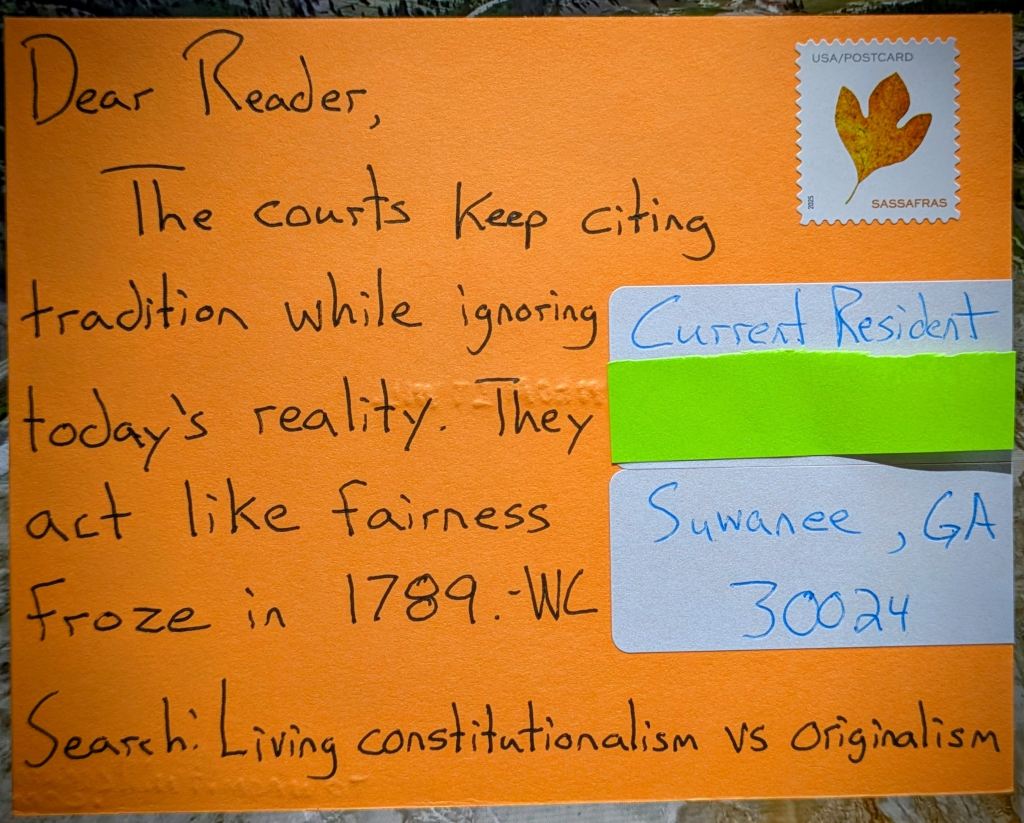
The Supreme Court is deeply divided between two ways of thinking about the Constitution: “originalism” and “living constitutionalism.” Originalism means judges should only consider what the Constitution’s words meant when they were first written—like freezing its meaning in time, even when society changes. Living constitutionalism is the idea that the meaning can change as America changes; judges use today’s values and realities to make decisions about rights and laws. Right now, most Supreme Court justices call themselves originalists, arguing that this keeps judges tied to the people’s original intentions and stops courts from making up new rules. Living constitutionalists, on the other hand, say sticking only to old meanings makes it impossible to solve current problems when laws never imagined things like the internet or modern civil rights battles.
For people in Georgia, the Supreme Court’s strong swing toward originalism can make life more unpredictable, especially around voting rights, criminal justice, and equality. Recent cases about how Georgia draws election districts, handles race in court trials, and deals with abortion clinics have all been shaped by justices asking, “What would the Founders say?” instead of “How does this affect Georgians today?”. For example, Georgia’s fight over voting maps is now decided based on rules from the 1800s, which can reduce protections against racial discrimination for voters in Atlanta and other urban areas. If the Supreme Court sticks to originalism in most big cases, laws affecting healthcare, social services, and public safety in Georgia could be harder to change to fit what communities need now. That means ordinary Georgians may struggle to get justice and fair treatment in court when the world changes faster than old constitutional ideas can keep up.
[Sources]
.
[Share | Subscribe | Follow]
.
 T W I W C